Astrophysics

Scenes from a Supernova
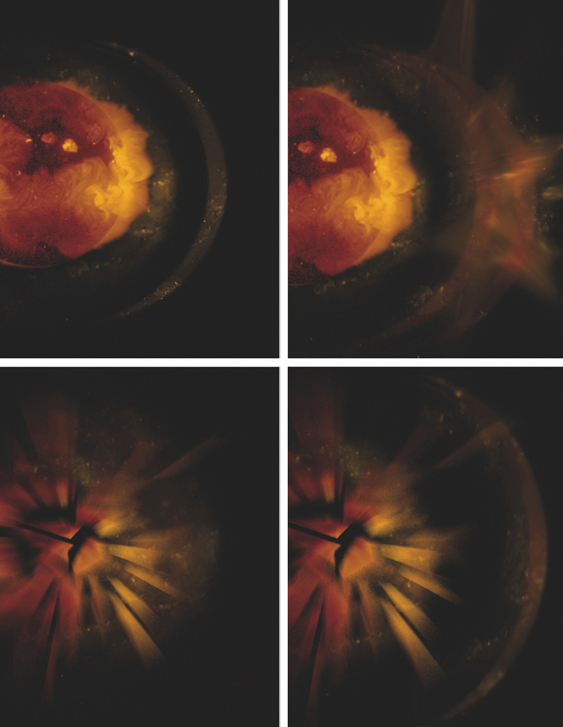
Scenes from a Supernova

Weizmann Institute scientists examined a particular type of exploding star supernova and gained new insights into why these stars end their lives in an explosion. A new supernova was observed with both Earth- and satellite-based X-ray and radio-wave telescopes. Researchers studied the material thrown off in the blast and analyzed the stages of the explosion. They showed that the exploding star was a white dwarf – an extremely compact star whose diameter is much smaller than that of our sun – which siphons off material from a companion star until it exceeds its stable weight limit, causing an explosion. The scientists set an upper limit on the size of a possible companion, showing it could not have been a particularly large star – excluding, for instance, a red giant scenario.
read more...

Interpreting the Movements of Galaxies

Interpreting the Movements of Galaxies

The universe behaves as though it contains much more matter than what's on display. That suppostion arises from Newton's laws of motion. This has led many scientists to postulate the existence of "dark matter," which has not yet been seen or detected. A Weizmann Institute scientist has suggested a new approach to the issue – one that doesn't invoke dark matter. His approach introduces an amendment to Newton's laws of motion. Calculations using the revised law show that observations correspond to measurements without the need to assume the existence of dark matter. The scientist later developed a theory combining the theory of general relativity with the revised laws of motion. This theory takes place in two space-time dimensions that affect each other.

read more...

Riding a Black Hole

Riding a Black Hole

A scientist from the Weizmann Institute of Science strengthened the hypothesis that the center of our galaxy – the Milky Way – is a massive black hole. Supermassive black holes have a mass equivalent to one million to one billion times the mass of our sun. Such black holes can be found at the center of many galaxies. The Institute scientist and his colleagues were able, for the first time, to follow a star completing an orbit around a known, but unusual, source of radiation in the center of our galaxy, thought to be a massive black hole. This star came as close as it could to the black hole: 17 light hours from the black hole's threshold. Scientists say that if the star were to get a little closer to the black hole, it would have gotten “sucked” into it.

read more...

The journey into the unknown

Weizmann institute scientists embark on a fascinating journey into the unknown, it their endeavor to better understand nature and our place in it.

In this station, you will see some the richness of the research fields in which our scientists work, as well as some of the new insights and discoveries that will shape our future.