Lasers

Laser Quest

Laser Quest

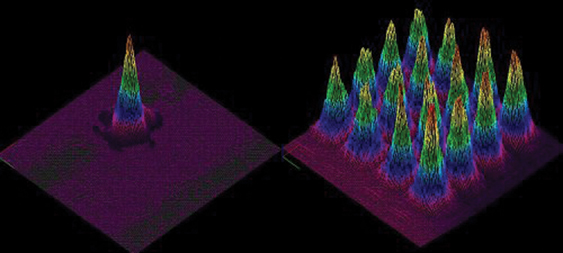
A high-quality, weak laser beam can be focused to a small and accurate point like that of a sharp dagger. A low-quality yet powerful laser beam, on the other hand, spreads out more like a blunt butter knife. Weizmann Institute scientists have developed a way to combine 16 weak laser beams into one powerful, high-quality beam. Developing such a laser is difficult to achieve since the minutest disturbance can knock the waves out of their superimposed state. To overcome this difficulty, the scientists developed a kind of "natural selection" device that allows those laser beams that meet the requirements to pass through, and rejects those that do not meet these requirements.
read more...

Excitement That Shows

Excitement That Shows

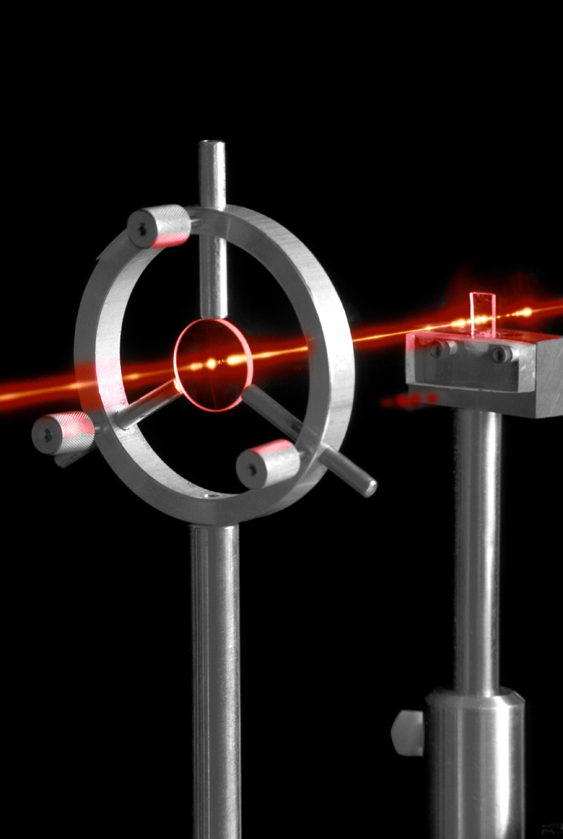
Could we use a laser on something the size of a molecule to break some chemical bonds and leave others intact? This ability could lead to future commercial applications. Weizmann Institute scientists have developed a theoretical method to analyze light emitted by excited molecules in order to trace, in retrospect, the geometric changes that occurred in the molecule during excitation. If scientists know which bonds are weakened or broken following excitation by light, it may be possible to manipulate chemical bonds more efficiently and selectively with the help of specially designed laser pulses.

read more...

Fast Focus

Fast Focus

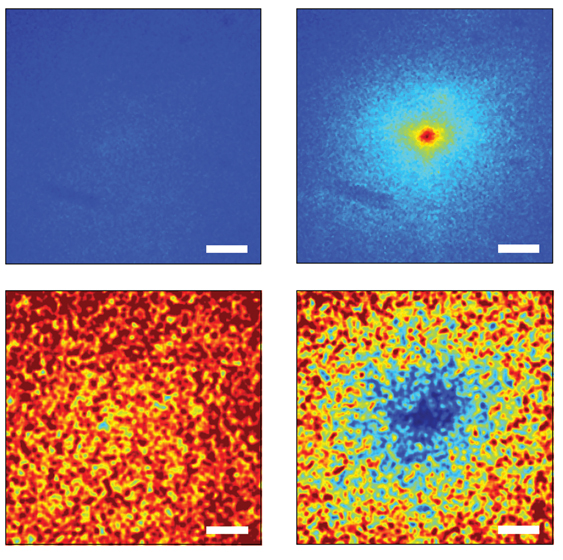
One way of cutting cleanly without causing harm to the surrounding area – say, in biological tissue – is to zap the target point with very brief (less than a millionth of a millionth of a second) flashes of highly concentrated laser light. There is no difficulty with this method when the target point is on an exposed surface. But when trying to focus the light underneath the surface – for instance, at tumors deep inside the body – the medium scatters the light. Weizmann Institute scientists have developed a method based on feedback: They created a system that can assess, in real time, how the light scatters. Using algorithms they developed, they created a beam that can “anticipate” the dispersal of its light and make the necessary corrections. This computerized system is able to tailor a laser beam to the tissue such that it is precisely and narrowly focused on the internal target.

read more...

The journey into the unknown

Weizmann institute scientists embark on a fascinating journey into the unknown, it their endeavor to better understand nature and our place in it.

In this station, you will see some the richness of the research fields in which our scientists work, as well as some of the new insights and discoveries that will shape our future.