Physics

A Super Surprise

A Super Surprise

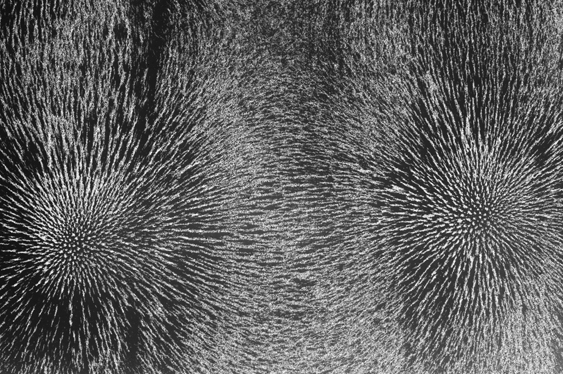
Weizmann Institute scientists investigate superconductivity – the ability of electric current to race through certain materials with no resistance when they are cooled to extra-low temperatures. Superconductors may be used, among other things, for the long-distance transmission of currents, or to create strong magnets to power very fast trains, particle accelerators, and more. The scientists deprived a material of its superconducting ability by activating a strong magnetic field. They found that a certain combination of current, voltage, magnetic field strength and temperature causes the material to completely lose its ability to conduct electricity. In other words, they discovered a phenomenon that was the exact opposite of a superconductor – a superinsulator.

read more...

Sling Effect in Clouds Brings on the Rain

Sling Effect in Clouds Brings on the Rain

Clouds are formed by warm water vapor rising. When a cloud cools, the vapor condenses into droplets that increase in size and are eventually pulled back to earth by gravity, causing rain. Simple as this cycle may sound, when and where exactly the rain will fall is extremely difficult to predict. A team of scientists at the Weizmann Institute scientists has revealed that turbulence in clouds can accelerate rain formation. They derived a mathematical formula that makes it possible to calculate how fast the tiny droplets within turbulent clouds cluster into heavy, rain-producing drops. The research may provide an effective tool for rain prediction.

read more...

Finding New Quasiparticles

Finding New Quasiparticles

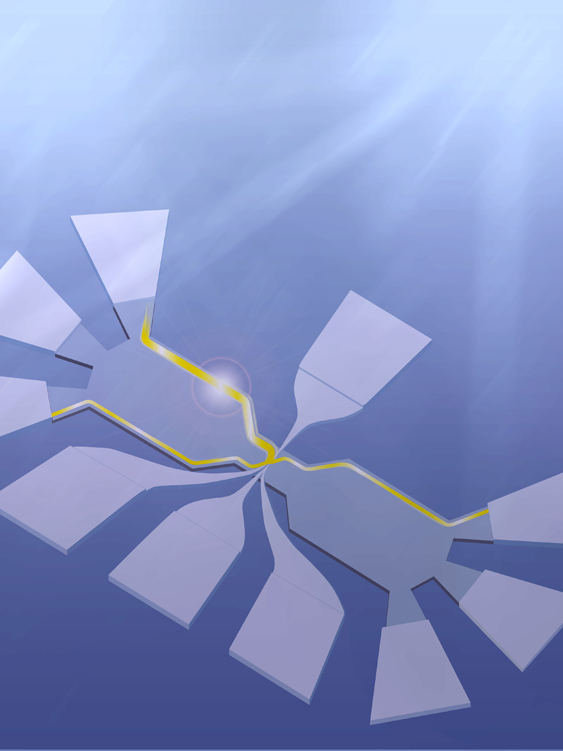
A decade after they discovered “quasiparticles” with charges of one-third and one-fifth that of an electron, Weizmann Institute scientists have succeeded in demonstrating, for the first time, the existence of quasiparticles with one-quarter charges. This finding could be a first step toward creating powerful and highly stable quantum computers. Although electrons are indivisible, if they are confined to a two-dimensional layer inside a semiconductor, chilled down to a fraction of a degree above absolute zero and exposed to a strong magnetic field that is perpendicular to the layer, they effectively behave as independent particles, called quasiparticles, with charges smaller than that of an electron. As opposed to odd factionally-charged particles, quarter-charge quasiparticles can store information, and this is why they have been sought as the basis of the theoretical quantum computer. The experiment conducted by the Weizmann scientists owes the finding of quarter-charge quasiparticles to an extremely precise setup and unique material properties: The gallium arsenide material they produced for the semiconductor was among the purest in the world.

read more...

The journey into the unknown

Weizmann institute scientists embark on a fascinating journey into the unknown, it their endeavor to better understand nature and our place in it.

In this station, you will see some the richness of the research fields in which our scientists work, as well as some of the new insights and discoveries that will shape our future.