Computer Science

Encryption while You Work

Encryption while You Work

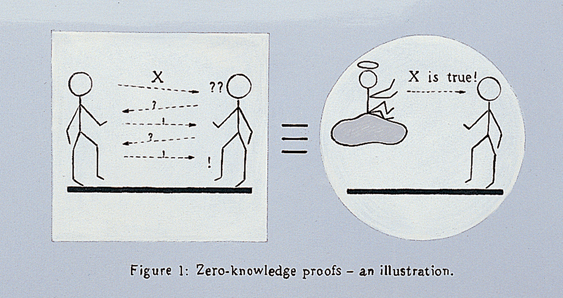
The increasing use of cloud computing – networks of shared, remote servers – leaves data vulnerable; traditional encryption methods cannot protect it. Scientists around the world have suggested encrypting the data in such a way that the server can perform the required actions when the information is still encrypted – an approach called “fully homomorphic encryption.” Weizmann Institute scientists have developed several new ways of making fully homomorphic encryption more efficient. They not only simplified the arithmetic, speeding up processing time, but showed that a mathematical construct used to generate the encryption keys could be simplified without compromising security.
read more...

The Art of Compromise

The Art of Compromise

We are often forced to choose between efficiency and exact accuracy when finding answers to complex problems, even on computer. If efficiency is important to us, the solution we obtain will not be completely accurate. If the exact solution is important to us, the computing process is likely to be slow and costly. Weizmann Institute scientists and colleagues show that opting for efficiency over accuracy may very often yield results that are close enough to perfect to be useful in many applications. They developed super efficient algorithms that were able analyze a variety of data found in very large networks. While not optimal, these algorithms were able to find a solution very close to the optimal with high probability.

read more...

Built to Fold

Built to Fold

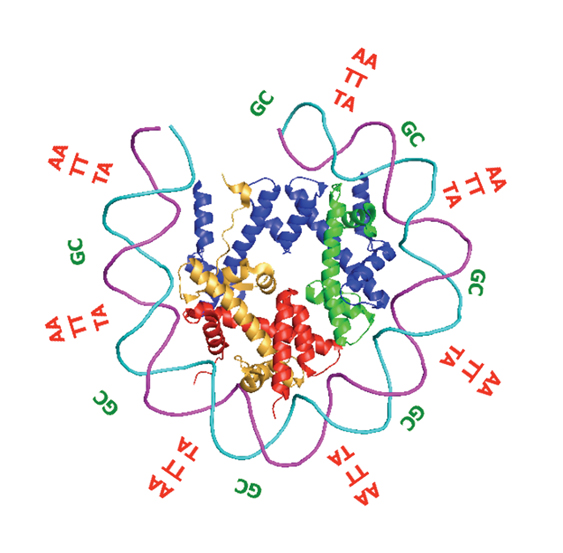
Weizmann Institute scientists discovered a new genetic code within the genome. It is made up of two genetic “letters” that repeat themselves periodically, appearing at intervals of 10 base pairs in certain regions of the genome. This repeating signal determines how the DNA sequence gets folded. When the code appears enough times throughout the length of the genetic sequence, it facilitates the bending of segments of about 150 base pairs into protein-DNA complexes called nucleosomes – neat, spherical beads strung on the DNA strand. These structures help pack DNA effectively within the nucleus. The scientists developed probabilistic models that enabled them to decode the nucleosomes, as well as predict their location within the genome according to the DNA sequence only.

read more...

Skeletons (and other Organs) in the Cell Family Tree

Skeletons (and other Organs) in the Cell Family Tree

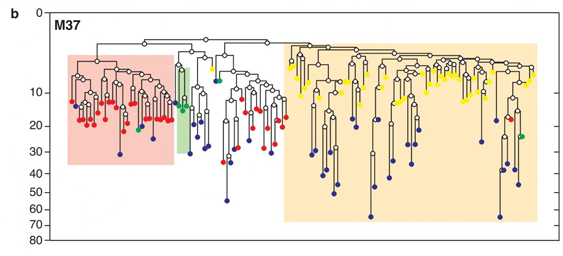
Just as tracing our ancestry can tell us much about ourselves, Weizmann Institute scientists aim to understand how cells come to be “who they are” by reconstructing lineage trees for cells. The method is based on mutations passed on to daughter cells during cell division. The scientists found that these mutations can be used to determine which cells are most closely related, and how far back they share a common parent cell, to create a "family tree". This method was used, among other things, to solve a mystery concerning ova renewal, answer questions about the development of muscle cells and more. In the future, doctors will be able to use this method to discover the history of individual cancer cells and to help them determine the best course of treatment.

read more...

The journey into the unknown

Weizmann institute scientists embark on a fascinating journey into the unknown, it their endeavor to better understand nature and our place in it.

In this station, you will see some the richness of the research fields in which our scientists work, as well as some of the new insights and discoveries that will shape our future.