Mathematics

Random Walks in Random Environments
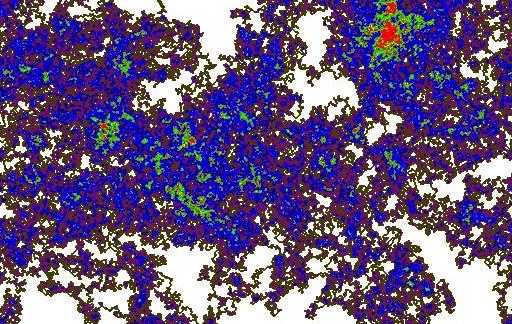
Random Walks in Random Environments

Each time a wanderer strolling along an unfamiliar branching path reaches an intersection, he faces a dilemma: Which way should he turn? By tracing the path of this random wanderer, one can try to make sense of the basic, underlying rules that direct his course. For instance, what happens if he simply chooses his direction on the basis of rolling dice? Is the wanderer guaranteed a return to his starting point? Weizmann Institute scientists showed that if the system is a two-dimensional lattice, then rolling the dice will bring him, sooner or later, back to his starting point. But in systems of three or more dimensions, this is not true. Solving this problem may help, among other things, in understanding the pathways of electrons in crystals.

read more...

Does God Play Dice?

Does God Play Dice?

"God does not play dice with the Universe." This was Einstein's famous retort to the uncertainty principle – nowadays one of the basic tenets of quantum physics. Since then, evidence suggests that certain aspects of material existence do seem truly random; they lack order and can never be completely predicted. Weizmann Institute scientists investigate highly chaotic systems: Due to their inherent instability, even simple laws (e.g., the laws of motion or Newton's laws) can produce unexpected behavior. Other scientists at the Institute use randomness to prove the existence of simple, multidimensional structures that are hidden as substructures within larger, complex formations.

read more...

The Universe, Step by Step

The Universe, Step by Step

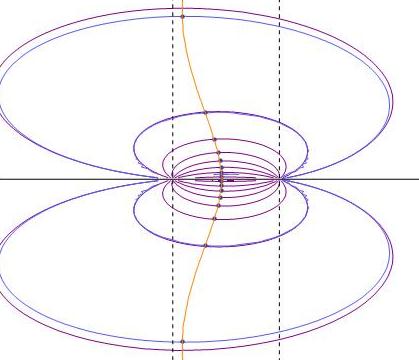
When will a system, such as the solar system, behave like a series of concentric orbits and when, in contrast, will the system's orbiting objects “escape?” This question, called the center focus problem, was posed by French mathematician Henri Poincare at the end of the 19th century, and it relates to the stability of solar systems and the possibility that planets such as the earth might “flee” the system. Weizmann Institute scientists use mathematical reasoning to answer such questions, including the ones we don’t yet know to ask about the world in which we live.

read more...

The journey into the unknown

Weizmann institute scientists embark on a fascinating journey into the unknown, it their endeavor to better understand nature and our place in it.

In this station, you will see some the richness of the research fields in which our scientists work, as well as some of the new insights and discoveries that will shape our future.