Nanoscience

Getting Nanowires into the Groove

Getting Nanowires into the Groove

Most nanowires grow up disorderly, making it difficult to realize their full potential in the electronics and electro-optics industry. Scientists at the Weizmann Institute have discovered a way to grow semiconducting nanowires horizontally on a surface and managed, for the first time, to direct their growth into well-aligned, millimeter-long structures – 100 times the length obtained by other methods. Semiconductors with controlled structures are at the core of the most advanced technologies, and this research will hopefully enable the production of semiconductor nanostructures with enhanced electronic and optical properties for a wide range of applications, among them transistors, LEDs, lasers, information storage media computers and photovoltaics.

read more...

Nanotube News

Nanotube News

There is a gap between the theoretical strength of a material and its actual strength, in part because of defects in its structure. Is it possible to bridge this gap? A study conducted at the Weizmann Institute shows that when it comes to nanotubes, the answer may be yes. The scientists tested the strength and mechanical properties of inorganic nanotubes. Inorganic nanotubes were first discovered at the Weizmann Institute but, because they are difficult to produce, they had not been examined extensively. In this study, the scientists put them through a series of stretching, bending and compression "exercises" while observing their behavior under a scanning electron microscope. The results showed that the nanotubes were as strong as the theory predicted and virtually defect-free.

read more...

Introducing Impurity

Introducing Impurity

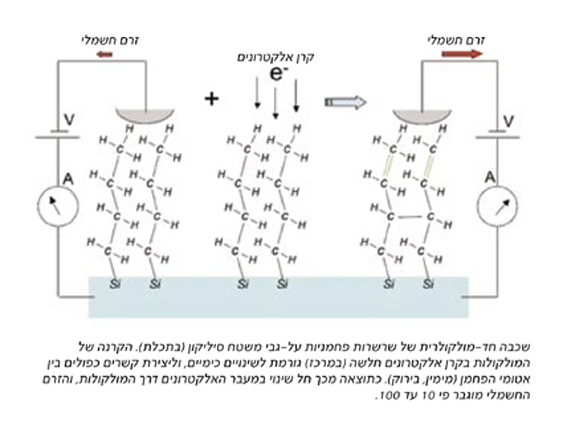
Sometimes, impurities are welcome. In semiconductors, for instance, small amounts of other materials are introduced into the semiconductor (doping), enabling electricity to flow through the semiconductor and allowing designers to control the electronic properties of the material. A team of scientists from the Weizmann Institute succeeded in applying this principle to molecular electronics based on semiconductors made from organic molecules and polymers, which are cheaper and more environmentally friendly. However, it is very difficult to first purify and then introduce impurities in a controlled manner. The scientists worked with a thin layer – the thickness of a single molecule – and showed, for the first time, that such doping of molecular electronic systems is, indeed, possible. This method may help broaden the use of organic monolayers in the field of nanoelectronics.

read more...

The journey into the unknown

Weizmann institute scientists embark on a fascinating journey into the unknown, it their endeavor to better understand nature and our place in it.

In this station, you will see some the richness of the research fields in which our scientists work, as well as some of the new insights and discoveries that will shape our future.