Materials Science

Just Rolling Along

Just Rolling Along

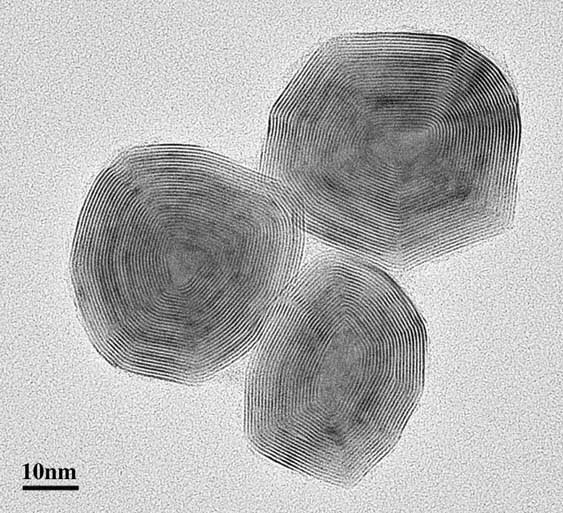
Weizmann Institute scientists have created a new kind of lubricant that promises to significantly increase the efficiency of machines by reducing friction. The new substance, which contains synthetic nanospheres, prevents friction between moving metal parts with an efficiency of up to 2.5 times that of existing lubricants. The nanospheres, made of tungsten disulfide, form closed nanostructures made of many layers, like an onion. Until this discovery, it was believed that only organic materials were able to form such closed, organized structures – called fullerenes. Weizmann Institute scientists were the first to discover that inorganic materials were also able to form fullerene-like structures.

read more...

Crowd Control

Crowd Control

Genes must work in the cramped quarters of the living cell or cell nucleus. But laboratory experiments seeking to emulate cellular activity typically use molecules floating loosely in solution. Weizmann Institute scientists created a system combining the convenience of the test tube with the crowded conditions in a cell. They developed a method for attaching fairly long strands of DNA perpendicularly onto a surface to create a thick, brush-like carpet. They then used the genetic brushes to learn how basic biological processes occur. The findings show that this system better simulates what happens in real conditions, revealing information on the relationship between the physical arrangement of the genes and their activities. This is the first step toward reaching the long-term goal: creating an artificial cell.

read more...

The Slick Joint

The Slick Joint

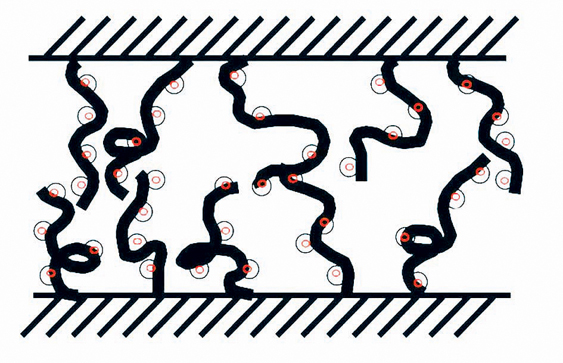
Nature has managed to evolve methods and materials that reduce friction to very low levels, even for joints operating at high pressures, such as hips and knees. However, after many years of use, even these systems suffer from wear and tear, causing damage to the joints. Weizmann Institute scientists have created a synthetic lubricant that seems to “compete” with the efficiency of natural systems. The molecular structure of the system mimics a double-brush system: “Bristles” made of long molecular chains are attached to opposite-facing surfaces. The system demonstrates effective friction resistance: When the two surfaces brush past each other, the molecular bristles try to avoid one another, enabling them to easily slide past.

read more...

How Sea Urchin Teeth Stay Sharp

How Sea Urchin Teeth Stay Sharp

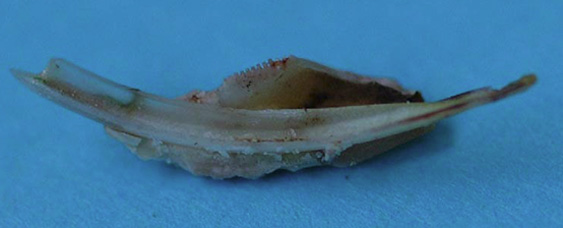
Sea urchins do not seem to belong to the world of modern technology, but Weizmann Institute scientists found, to their surprise, that these creatures use advanced tools to dig out their hidey holes. Urchins use their teeth to dig holes that fit their globular bodies, so their teeth need to be harder and stronger than the rocky limestone they dig through. But the teeth themselves are made almost entirely of calcite – the same calcite that makes up much of the limestone. How is this possible? Weizmann Institute scientists have solved the mystery: The secret lies in crystalline structure. The teeth contain small crystals that are harder and denser than those of pure calcite; these are concentrated at the grinding tip of the tooth, particularly in the tip's center, where the most force is being exerted in the course of grinding.

read more...

The journey into the unknown

Weizmann institute scientists embark on a fascinating journey into the unknown, it their endeavor to better understand nature and our place in it.

In this station, you will see some the richness of the research fields in which our scientists work, as well as some of the new insights and discoveries that will shape our future.